
How to Search Civil Dockets
Start at Indiana MyCase. Got a full case number? Use the Case tab. Searching a person or business works better under the Name tab. There you can narrow results to Civil, Family, or Probate. A Jasper filing number opens with county code 37. Court code C01 means Circuit, and D01 means Superior. Filter by court, type, filing dates, and status. That keeps a common name from burying you in results.
Before opening a result, confirm the court, case type, status, filing date, and party roles all line up. Then read the CCS from the first filing to the newest entry. MyCase is only the remote channel. The clerk desk at Circuit or Superior can answer questions by phone. The counter handles inspection and copies. When an index lists a document without linking it, ask the clerk for that document by name instead of guessing what it says.
- Choose Case or Name and set the Jasper court when known.
- Select Civil, Family, or Probate based on the dispute or petition.
- Confirm the case prefix and each plaintiff, defendant, petitioner, or respondent role.
- Read service, filings, motions, settings, orders, and judgment in date order.
- Contact the Jasper County Clerk for an available paper, certified copy, or older file.
Jasper Civil Docket Codes
The case-type code shows which civil path a case follows. CC means civil collection, CT means tort, and PL means plenary. MF marks a mortgage foreclosure, SC a small claims case, and EV an eviction. Family matters use DR plus the newer DC or DN types. Probate-related codes include ES, EU, EM, GU, and TR. A few others appear too. RS marks reciprocal support, PO means protection order, and XP is expungement. TS or TP covers tax matters.
CC marks a civil collection. CT marks a civil tort. PL is plenary, meaning a general civil action that carries no other specific type, while SC covers small claims. MF signals mortgage foreclosure and GU a guardianship.
Older Jasper County civil dockets may still carry codes like CP or MI. A code names the case family, nothing more. It never tells you the outcome, and it helps route a clerk question to the right desk.
What a Civil Docket Shows
A civil CCS opens with the court, case number, case type, filing date, and status. Parties appear by procedural role, with attorneys linked when that data is public. The dated entries that follow can include the complaint or petition, service, and an answer. Motions and hearing notices may appear. Court orders, a judgment, costs, and post-judgment steps can show up later. One caution applies to family and probate files. Their docket may show event labels while keeping the underlying document out of view.
| Header | Jasper court, number, type, filed date, status, and related cases. |
|---|---|
| Parties | Plaintiff and defendant or petitioner and respondent, with roles kept distinct. |
| Service | Summons, return, appearance, or other notice events when entered. |
| Filings | Complaint, petition, answer, motion, response, or other dated filing. |
| Settings | Hearing date, session, court officer, type, and result when available. |
| Outcome | Order, judgment, dismissal, default, settlement, transfer, or later enforcement. |
An order on one motion can reset the schedule without ending the case. Always read through the newest CCS entry before deciding a matter is closed.
Visible Jasper Cases, Hidden Exhibits
A case in the public index is one thing. A document you can actually open is another. Indiana's online and in-person access matrix spells out how availability shifts with case type and document. Plenty of ordinary civil indexes and final orders are online. Domestic-relations, guardianship, adoption, and older filings may be in-person-only, redacted, or excluded entirely. Medical records, financial affidavits, child-related records, and protected personal data are the usual limits.
That official matrix sets out each channel's reach.
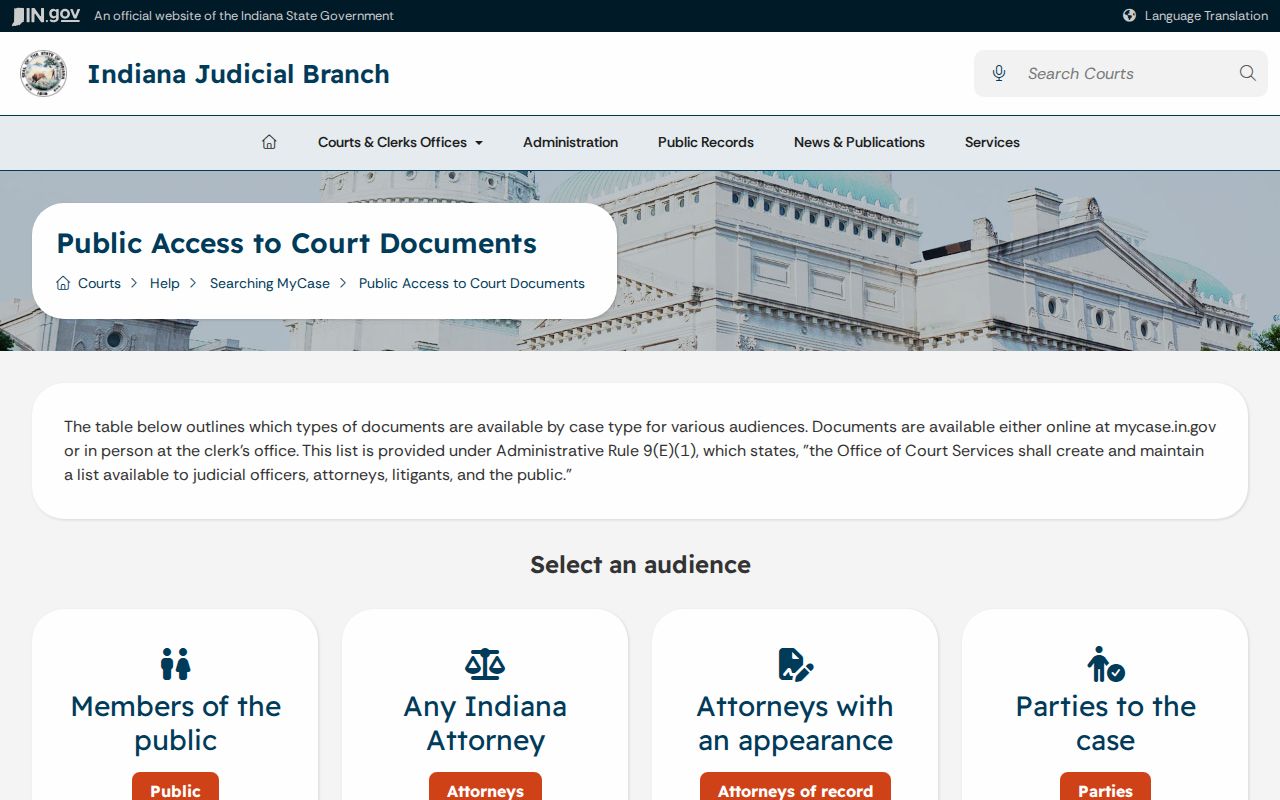
Use the matrix to pick your next access channel. It never overrides a statute, a court order, or the Access to Court Records Rules in a given Jasper County civil case.
Types of Civil Cases on the Docket
Collection files tend to move in a straight line. Complaint, service, answer, judgment, then collection after judgment. Tort and plenary matters run longer. Expect more motions, discovery disputes, scheduling entries, and sometimes a jury demand. Foreclosure cases add service on several parties plus sale-related events later. Small claims keep a simpler path. Defaults, judgments, garnishments, and other post-judgment work still show up there.
Family, probate, estate, guardianship, and trust cases deserve more care. Their public captions or event indexes may reveal far less than an ordinary collection docket. Mental-health cases are excluded in full under current rules, and adoption access is sharply restricted. Pick the right case family before searching. Then respect the limits the official system and the clerk display.
Jasper Civil Filing Paths
The official Jasper court cases and fees page ties civil codes to local filing routes. It posts $157 for a one-defendant CC, DR, MH, MI, or RS filing. CT and PL add a posted $75 jury fee. That makes a $232 path. Each added defendant costs $10 more. Mortgage foreclosure starts at $157 plus those added-defendant charges.
| Filing path | Posted amount | Important limit |
|---|---|---|
| Ordinary listed civil | $157 | One defendant; verify current type and total. |
| CT or PL with jury fee | $232 | Includes the posted $75 jury fee. |
| Small claims, paper | $97 | One defendant; other parties and service can add costs. |
| Small claims, e-filed | $87 | One defendant; garnishees and service follow separate rules. |
| Probate, guardianship, trust | $177 | Filing amount, not a copy or transcript fee. |
These are filing fees only. They don't cover copies, certification, service, or later motions. Confirm the current amount and accepted payment with the clerk and the Indiana Trial Court Fee Manual before you file.
Settings and Hearings on Civil Dockets
A civil setting is reserved court time, nothing more. The entry might cover a status conference, a motion hearing, a pretrial conference, a fact-finding hearing, a review, or a trial. The label tells you nothing about who won. For the real outcome, open the CCS and read the resulting entry or order. One motion can be granted while other claims in the same case keep moving, and a hearing that was canceled may still sit in the history as a past event.
MyCase lists upcoming events. Indiana CourtCal is a different tool for near-term settings, and it currently includes Jasper Superior Court among its participating courts. Circuit Court dates may take the CCS or a quick call to confirm. CourtCal holds no civil documents, though. Need a filed motion or a final order? Go back to MyCase. Or ask the clerk.
Jasper Civil Transfers Keep One Case
Jasper Circuit and Jasper Superior both handle civil and probate matters. Local rules let cases move between the two courts to even out the workload, and the CCS can also show a special judge picked through the local process. None of that opens a new civil action. Search the original 37C01 or 37D01 number. Let the docket itself point you to a linked case.
Skip judge names as search keys, since assignments shift. The uniform case number never changes and keeps the filing court attached to it. A transfer or special-judge entry can confuse anyone. Read the order tied to that event when it is public. Or ask the clerk for that specific order.
Public Access to Civil Dockets
Under Indiana Access Rule 4, court records are presumed public unless a rule, statute, or order says otherwise. Some categories are shielded. Access Rule 5 protects medical records, mental-health records, substance-abuse treatment, GAL and CASA materials, custody evaluations, and other sensitive filings. So a civil case can have a public CCS that still contains redacted or non-public documents. Mental-health cases are closed entirely. Adoption records face strict limits.
Access depends on the record. Remote access, counter inspection, and full exclusion are different outcomes.
Ask the Jasper County Clerk about a named filing. Do not treat the lack of a download link as proof that no document exists.
Indiana's Access to Public Records Act, IC 5-14-3, sets the general public-record framework, while the judicial access rules govern court records specifically. The rules effective July 1, 2026 keep access open but spell out protected categories and the extraordinary Rule 9 process.
Read Jasper Civil Results in Order
Reading a Jasper County civil docket works best in filing order. Begin with the complaint or petition. Note who filed it. From there, trace service or appearance, the answer or response, motions, settings, and orders. A motion entry is not a ruling. Judgment, dismissal, default, settlement, transfer, and post-judgment events come next. A default is not a dismissal. Neither can be guessed from a missed setting alone.
Sometimes the docket shows an index entry only. Jot down the court, case number, entry date, and title. Then call the Circuit civil desk at 219-866-4926 or 219-866-4921. The Superior desk answers at 219-866-4912, 219-866-9451, or 219-866-4922. Ask about inspection, an ordinary copy, or a certified copy. That specific request beats a name-only search every time.